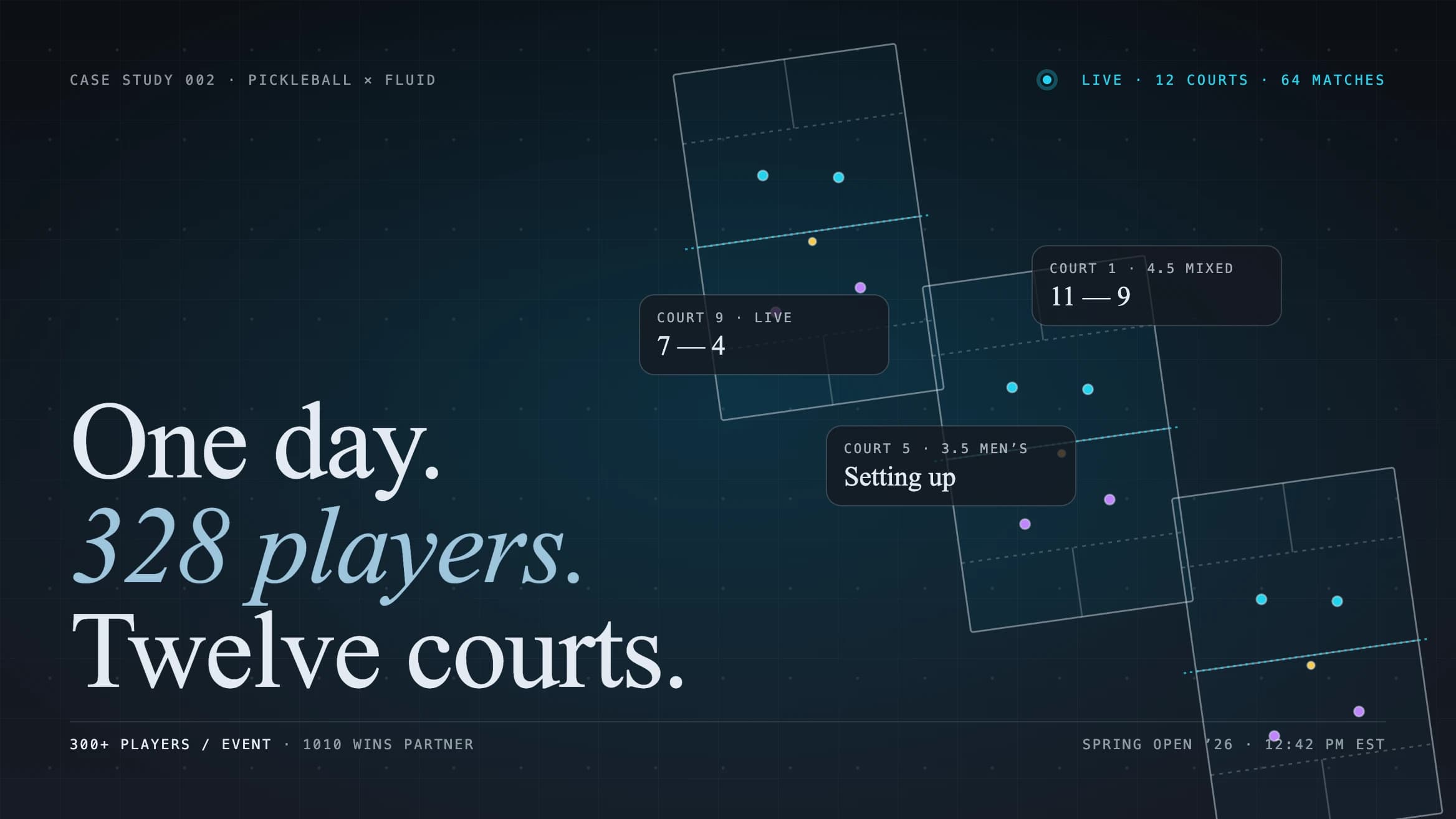
002 Pickleball operated tournaments across Texas before adopting Fluid.
As tournament participation and operational complexity continued increasing, the 002 team began evaluating what type of infrastructure could support long term scale without compromising execution or player experience.
Rather than making an immediate transition, 002 operated events across both Fluid and legacy tournament infrastructure over an extended period while evaluating how each system performed under real tournament conditions.
The process was not simply about replacing existing tooling. It was about determining which operational infrastructure could better support large scale tournament execution over the long term.
“The process was never about replacing software. It was about building infrastructure capable of supporting scale.”
The evaluation.
The eventual consolidation onto Fluid came after prolonged real world operational evaluation rather than short term feature comparison. Over time, the answer became clear.
002 ultimately consolidated its tournament operations onto Fluid.
Building around real tournament operations.
As tournament sizes increased, operational efficiency became increasingly important. Court flow, score reporting, communication, and live event coordination all became critical parts of the player experience.
During Fluid's early tournament infrastructure development, close collaboration with organizers like 002 helped surface operational bottlenecks that much of the industry had simply accepted as normal.
One of the clearest examples was score reporting. At the time, tournament staff spent significant time printing score sheets, manually cutting them, organizing them into baskets, maintaining those baskets throughout the event, and tracking which courts and players were taking them.
During peak tournament periods, staff continuously redistributed score slips across active courts while organizers manually coordinated updates throughout the day. The workflow created operational friction across the entire tournament environment.
Rather than simply optimizing the paper workflow itself, Fluid stepped back and questioned why the workflow existed at all.
“Fluid questioned workflows the industry had simply accepted as normal.”
Those observations contributed directly to the development of Fluid's Score Kiosk workflow, which 002 became one of the earliest organizers to adopt. By allowing players to report scores directly after matches, tournaments became significantly more connected operationally with real time bracket updates, smoother court transitions, and reduced manual bottlenecks throughout the event.
With the introduction of Score Kiosk, entire layers of operational overhead simply disappeared.
- No printed score sheets.
- No cutting paper.
- No maintaining baskets.
- No manually tracking score slips across courts.
Just connected tournament operations through a streamlined live workflow.
At the time, much of the industry still relied heavily on fragmented communication systems and paper based coordination. The shift represented a fundamentally different way of thinking about tournament infrastructure. The focus was never just software. It was operational infrastructure built around real tournament environments.
Evolving tournament workflow.
Legacy workflow
- Print score sheets every round
- Cut and organize paper slips
- Maintain physical score baskets
- Manual score coordination
- Delayed bracket progression
- Fragmented tournament communication
Fluid workflow
- Players report scores digitally
- Real-time score updates
- Connected live operations
- Streamlined court flow
- Instant bracket visibility
- Centralized operational environment
Tournament operations at scale.
As 002 continued scaling tournaments on Fluid, operational complexity increased significantly. Managing hundreds of players across simultaneous brackets and active courts required infrastructure capable of supporting real time tournament coordination without slowing down event flow.
This included successfully operating tournaments with more than 600 players on Fluid while maintaining the operational quality their events became known for across Texas.
During active tournament windows with hundreds of players moving simultaneously between courts, score reporting and court flow became operationally critical. With Score Kiosk integrated directly into tournament operations, players could report scores immediately after matches while brackets updated live across the tournament environment.
The result was faster progression between rounds, improved operational visibility, and a more connected experience for players, organizers, and spectators throughout the event.
“The best tournament infrastructure often becomes invisible to the people running the event.”
Continuing to scale on Fluid.
As operations continued growing on Fluid, 002 tournaments saw measurable increases across participation, revenue, and player acquisition while maintaining the execution quality their events became known for across Texas.
Across one comparison period between events operated on Fluid:
The tournaments also saw strong returning player participation alongside expanding audience reach and increased female player representation. As operational workflows became more streamlined through Fluid, the 002 team was able to spend less time managing fragmented tournament processes and more time focusing on the player and spectator experience throughout the event.
Rather than being consumed by manual coordination and operational overhead, the team could direct more attention toward engagement, hospitality, communication, and the overall quality of the tournament environment. The efficiencies were not simply about saving time. They created more operational space for the things players actually remember.
The growth reflected more than increasing registrations alone. It demonstrated the ability to scale tournament operations while continuing to deliver a high quality player experience at larger operational volumes.
“The question was never whether Fluid could support growth. It became how far organizers could scale once operations were no longer constrained by fragmented infrastructure.”
Raising the standard for tournament execution.
Over time, 002 tournaments became widely recognized across Texas for operational quality, player experience, and execution. Their transition to Fluid was not driven by hype or short term trends. It came from real operational comparison and a belief that modern tournament infrastructure would become increasingly important as competitive pickleball continued scaling.
As competitive pickleball continues evolving, tournament infrastructure is increasingly becoming a competitive advantage rather than simply operational software. Organizers are no longer evaluating platforms based solely on registration functionality. They are evaluating how effectively their infrastructure supports scale, player experience, communication, and live event execution simultaneously.
002 was one of the early examples of that shift.
FAQ
Did 002 Pickleball switch to Fluid immediately?
No. They operated events on both Fluid and legacy tournament infrastructure over an extended period before consolidating onto Fluid.
What is Score Kiosk and how did 002 Pickleball use it?
Players report scores after matches while brackets update live. 002 was among the earliest adopters after paper-based score sheet workflows were replaced.
How large are 002 Pickleball tournaments on Fluid?
They have operated events with more than 600 players while maintaining the operational quality their events became known for across Texas.
What results did 002 Pickleball see on Fluid?
In one comparison period between Fluid-operated events: 61% tournament revenue growth, 31.3% player participation growth, and 255 new player registrations, alongside strong returning participation.
See how directors run registrations, brackets, and live ops on Fluid.
Set up your next event with Fluid's tournament tools.
This story uses Fluid's tournament software. Multi-division tournaments are separate from club subscriptions.