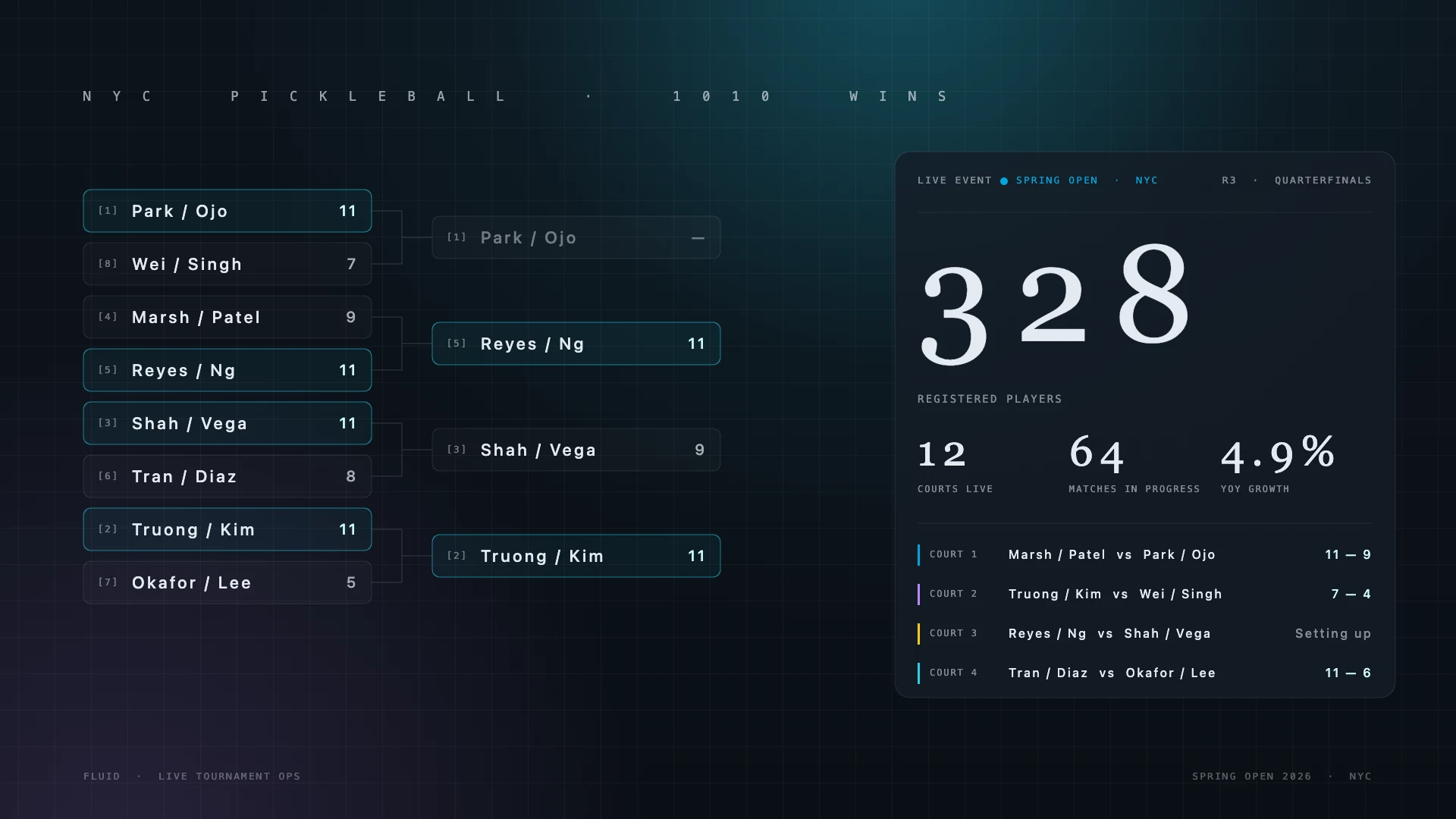
There's a difference between software that can technically run a tournament and infrastructure that actually helps organizers create experiences people want to come back to.
That difference becomes increasingly visible once events scale into hundreds of players, multiple brackets, playoffs, spectators, vendors, live communications, and nonstop moving parts compressed into a single day.
Anyone who has operated a large tournament knows there are hundreds of things happening simultaneously while someone is still asking where their partner is.
As tournaments scale, operations become increasingly fragile. Delayed bracket updates create court backups. Communication gaps compound quickly across active divisions. Even small operational inefficiencies become highly visible to players at scale.
Scaling without losing atmosphere.
Running tournaments at scale requires much more than software.
Players notice when environments feel effortless. They notice even faster when they don't — long check-in lines, confusing communication, scheduling delays, cold environments. Players remember those things far longer than who won gold.
“Too much dependence on technology creates cold experiences. Too little infrastructure creates chaos.”
That's where organizers like Eric Ho and NYC Pickleball stand out.
Over the years, Eric and his team have built some of the most community-driven tournaments in New York City and the surrounding areas. The challenge was figuring out how to continue scaling those events without losing the energy and atmosphere that made players want to return in the first place.
Operating tournaments with more than 300 players inside a single-day environment compresses operational complexity into extremely tight windows. Court utilization, bracket progression, communication, and player flow all have to operate with precision for the atmosphere to remain smooth.
The transition.
Before moving to Fluid, NYC Pickleball operated on PickleballBrackets.com, one of the most widely used tournament platforms in the competitive pickleball ecosystem.
At the time, transitioning an established tournament community onto a newer platform carried real operational and reputational risk. Naturally, there were questions around player adoption:
Would players actually transition over to a competing platform? Would participation slow down? Would the community resist learning a new system?
Instead, the opposite happened.
The response on Fluid was even stronger. Players adapted quickly and the overall experience resonated more deeply from both a usability and operational standpoint.
Since then, NYC Pickleball's player base has continued growing year over year with both returning competitors and new players consistently participating in events.
Part of that came from Fluid becoming known for a more modern, intuitive, and player-friendly tournament experience. But operational infrastructure played an equally important role behind the scenes.
“Technology should remove friction, not remove humanity.”
Building infrastructure around live tournament operations.
As NYC Pickleball continued scaling, tournament operations required increasing levels of coordination across scheduling, communication, score reporting, bracket progression, and player flow.
The goal was never to make tournaments feel robotic. It was to remove friction while preserving the atmosphere that made the events feel personal and community driven in the first place.
For players, the experience became cleaner, faster, and easier to navigate throughout the day. For organizers, operations became significantly more manageable under scale without sacrificing the human side of tournament environments.
The best tournament infrastructure often becomes invisible to the people running the event. When operational systems function properly, organizers spend less time managing friction and more time focusing on hospitality, engagement, communication, and the player experience itself.
Fluid's infrastructure also continued evolving through constant feedback from organizers and players operating real tournaments every single week. That continuous operational feedback loop became a major part of how the platform matured over time.
“Players are not only showing up to compete. They are showing up to feel part of something.”
Sustained growth at scale.
Today, NYC Pickleball tournaments operated on Fluid have grown into large-scale one-day events with more than 300 players while still maintaining a smooth and elevated atmosphere throughout the day.
In partnership with 1010 WINS, the events continue attracting large numbers of returning players while consistently introducing new competitors into the community.
Across one recent comparison period:
The tournaments also maintained strong returning player participation while continuing to expand audience reach and increase female player representation year over year.
Rather than sacrificing atmosphere as events scaled, NYC Pickleball continued building environments where players felt connected, welcomed, and engaged throughout the tournament experience.
A large part of that success comes from the environment Eric Ho and his team have created around the events themselves.
FAQ
How many players do NYC Pickleball tournaments run on Fluid?
NYC Pickleball operates large-scale one-day events with more than 300 players, with continued year-over-year growth in both returning competitors and new registrations.
What platform did NYC Pickleball use before Fluid?
NYC Pickleball previously ran tournaments on PickleballBrackets.com before transitioning to Fluid. Player adoption on Fluid was strong from the start, with participation continuing to grow year over year.
Who runs NYC Pickleball tournaments?
Eric Ho and the NYC Pickleball team have built some of the most community-driven tournaments in New York City and the surrounding areas, scaling events while preserving the atmosphere that keeps players returning.
See how directors run registrations, brackets, and live ops on Fluid.
Set up your next event with Fluid's tournament tools.
This story uses Fluid's tournament software. Multi-division tournaments are separate from club subscriptions.